
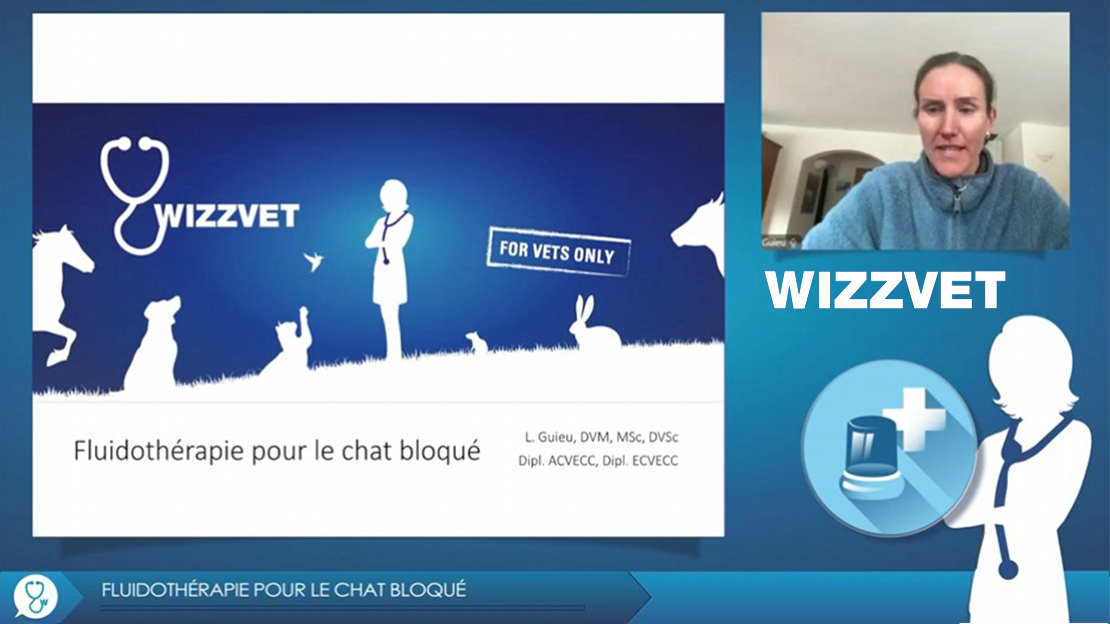
Fluidothérapie pour le chat bloqué

- Évaluer l’état d’hydratation d’un chat bloqué en se basant sur les paramètres cliniques
- Calculer un plan de fluidothérapie complet, incluant correction de la déshydratation, besoins de maintenance et pertes en cours
- Choisir le type de fluide approprié (cristalloïdes isotoniques, Ringer Lactate, etc.) selon l’état métabolique et électrolytique du patient
- Surveiller la production urinaire et le poids afin d’ajuster le débit de perfusion et identifier une diurèse post-obstructive
- Adapter et diminuer progressivement la fluidothérapie en fonction de l’évolution clinique, de la réhydratation et des paramètres biochimiques
Dr. Liz Guieu obtained her DVM from the University of Liège, Belgium in 2008. Afterwards, she completed a rotating internship followed by an Emergency and Critical Care fellowship at the Vet School of Maisons-Alfort (Paris, France).
She became a diplomate of the American & European College of Emergency and Critical Care (ACVECC) in 2016 after completing her residency at the University of Guelph (Ontario, Canada).
She has recently joined Colorado State University in beautiful Fort Collins, CO as a Clinical Assistant Professor.
Her primary interests include mechanical ventilation, sepsis, patient care and developing a strong nursing team.
She became a diplomate of the American & European College of Emergency and Critical Care (ACVECC) in 2016 after completing her residency at the University of Guelph (Ontario, Canada).
She has recently joined Colorado State University in beautiful Fort Collins, CO as a Clinical Assistant Professor.
Her primary interests include mechanical ventilation, sepsis, patient care and developing a strong nursing team.